
All figures come from Displayce’s own media platform data. They cover campaigns activated between January 1 and October 12, 2026, compared with the same period in 2025.
Since the beginning of 2026, 454 programmatic DOOH campaigns ran across Belgium, the Netherlands and Luxembourg on the Displayce media platform. That’s 21% more than last year, for 385 million impressions (+47%). The average budget per campaign rose by 18%.
Impressions are growing more than twice as fast as campaigns. Advertisers in the region have moved past testing pDOOH. They’re committing more to each campaign and making every screen count. Here are four things the data tells us.
1. Three countries, three very different markets
BENELUX is often treated as one market. On the ground, it behaves like three.
Belgium is where Displayce has the longest track record. Displayce has worked with Belgian agencies and media owners the longest, and it shows: Belgium accounts for 66% of BENELUX campaigns on the platform, across 20 media owners and 4,770 screens. Brussels and Antwerp lead the region, and pDOOH is now a regular part of Belgian media plans.
The Netherlands is the most mature programmatic market, with the largest inventory. 31 media owners and more than 20,000 screens cover an unusually wide range of environments, from city centres to gyms and retail. Amsterdam completes the top three cities.
Luxembourg is the cross-border market. With 4 media owners and 220 screens, it’s compact. Its agencies make up for it by planning well beyond their borders, especially towards neighbouring France.
2. The weather now has a say in the media plan
The number of campaigns using contextual triggers grew 4.5x compared with 2025. A trigger ties delivery to a real-world signal: the ad runs when the conditions are right, and stays off when they’re not.
Weather is the most used trigger, also up 4.5x. Advertisers set their campaigns to run with rain, sunshine, temperature thresholds or a high UV index, so the message matches what people feel when they step outside.
Road traffic triggers are new in 2026: campaigns switch on when traffic is dense or blocked, reaching drivers when they’re stuck and paying attention.
Airport triggers, based on real departure and arrival times, and air quality triggers complete the picture.
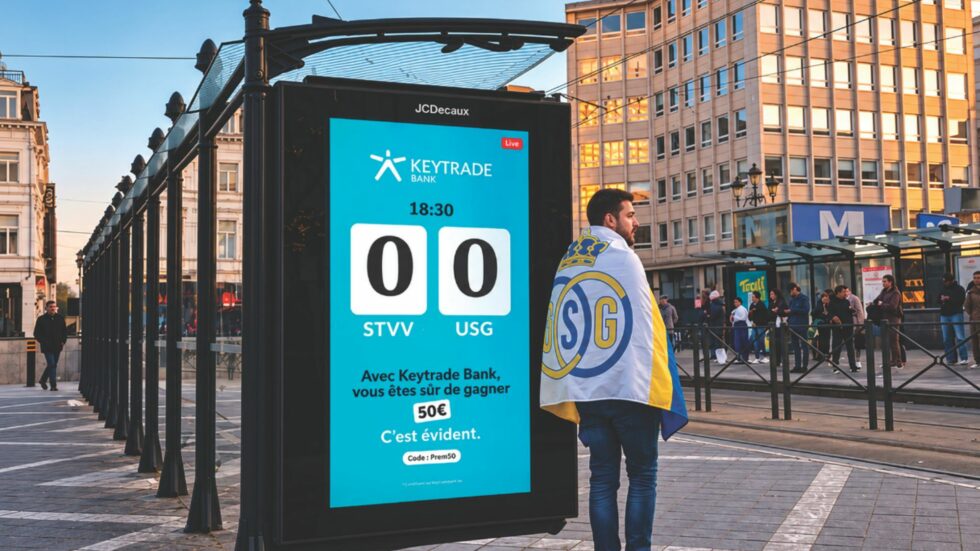
Keytrade Bank took the idea further. The bank followed Belgium’s event calendar for a full year, around twenty events across 21 cities, with a dedicated creative for each one: live scores on screen during football matches, artists’ own lyrics around their concerts. Discover how Keytrade Bank turned DOOH into creative reactions to Belgium’s events
Our Event Trigger makes this approach available to every advertiser: pick from six event categories (concerts, conferences, sports, family events and more) and run your campaign around the venue, before and after the event.
Data sharpens the targeting side too. Campaigns using audience data doubled in 2026, and campaigns using point-of-interest (POI) data rose by 45%. Context tells you when to show up. Data tells you who you’re talking to.
3. Who’s activating pDOOH: budgets follow people into their daily routines
Retail & e-commerce leads with 15.7% of campaigns, followed by entertainment & media (13.9%), banking & insurance (12.4%), the public sector (11.5%) and energy & utilities (10.8%). When five very different sectors share the medium this evenly, pDOOH has stopped being a niche choice.
What sets BENELUX apart is where these campaigns run. Beyond the street, budgets are moving into the places of everyday life and consumption. Supermarket entrances now rank among the top five environments, putting brands a few steps from the shelf. Gyms are the stand-out: the number of campaigns running there grew by 60%, and nearly 1 in 5 campaigns now includes gym screens.
The logic is simple. People go to the gym and the supermarket every week, at predictable times, in a predictable frame of mind. For an advertiser, that’s a routine you can plan around.
4. A self-sufficient market that plays across borders
95% of campaigns in BENELUX run in self-service mode. Agencies plan, activate and optimise their pDOOH campaigns themselves.
Their buying choices point the same way. 51.5% of campaigns rely exclusively on Always On Deals. The aim is to keep the brand on screen all year round, while staying free to step up activity around key commercial moments. That says a lot about the market’s maturity: pDOOH has earned a permanent place in BENELUX media plans.
26.6% of the campaigns bought by BENELUX agencies run outside the region, up from 19.1% in 2025. A team based in the region can run screens internationally from the same platform, with the same workflow. Your headquarters no longer sets the limits of your media plan.
The takeaway
BENELUX has moved past experimentation. Each country has its own profile, but the direction is shared: agencies buy with confidence, follow people through their daily routines and let real-world signals decide when their message appears. In this region, pDOOH now reacts to the world around it.
Curious what a contextual DOOH strategy could look like for your brand? Get in touch with the Displayce team.

