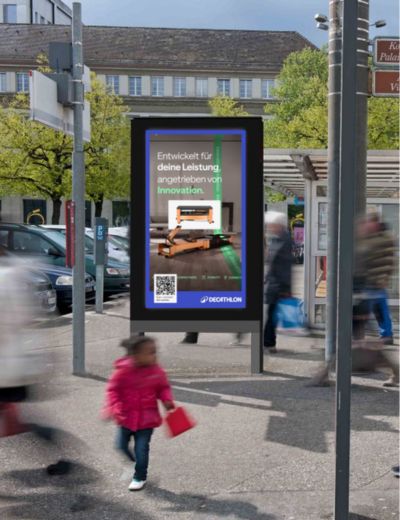

We spoke with Quentin Perceval, Digital Media Planner at Decathlon Switzerland, about the insights gained from a year of strategic Digital Out-of-Home campaigns in a complex, language-fragmented market. Decathlon’s approach perfectly illustrates the philosophy that context is key in Programmatic DOOH, leveraging data and hyper-localisation to achieve both brand-building and performance-based goals. Discover the success story.
From fragmentation to hyper-localisation: mastering linguistic context
The primary challenge in Switzerland is its market split into German, French, and Italian regions. For Decathlon, the fundamental lesson was that media strategy must become acutely aware of its environment, a core principle of contextual DOOH execution.
Rather than running a single, national campaign, Decathlon’s media strategy was built around a profound understanding of the audience’s physical and linguistic context.
This strategic budget division, alongside local adaptation of the creative content, ensured maximum relevance. By tailoring the message to the local language, Decathlon maximised its audience engagement, ensuring that the environment (the linguistic region) strengthened the message, aligning directly with the principle of contextual awareness.
Programmatic DOOH: a full-funnel, context-rich channel
Decathlon used Programmatic DOOH as a full-funnel solution, addressing two distinct, yet equally important, objectives: broad brand coverage and specific performance activation echoing the industry shift from DOOH as a “digital poster” to a flexible performance channel.
It allowed Decathlon to achieve nationwide visibility across high-traffic areas like train stations, securing brand coverage that sustained overall growth.
Crucially, the platform’s flexibility also supported micro-level performance marketing. Campaigns dedicated to specific stores for events like “social runs” or new openings demonstrated the ability of pDOOH to drive immediate local action, connecting the offline environment with potential customer action.
The next frontier: contextual data and external triggers
The most exciting development for Decathlon is the enhanced use of data to harness external triggers, the most dynamic form of contextual DOOH.
Decathlon successfully ran dynamic content tests by adapting creative based on real-time data:
- When it was raining in a specific city, the screens displayed waterproof gear.
- When it was sunny, they showed summer and outdoor sports products.
This use of real-time weather data as a trigger is a prime example of leveraging context to make advertising immediately relevant and useful to the audience in their current mindset and environment.
Looking ahead, the focus is on deeper data integration for greater accuracy and improved measurement, a commitment to establishing clarity of KPIs.
Results and impact: driving engagement and consideration
The strategic combination of contextual creativity, local targeting across 10 cities, and real-time optimisation delivered significant uplift in key brand metrics, reinforcing Decathlon’s position as a trusted partner for sports enthusiasts.
The campaign results confirm the effectiveness of this approach.
These results were achieved through the programmatic ability to target high-footfall venues and use real-time delivery (custom dayparting) to enhance engagement.
These results were achieved through the programmatic ability to target high-footfall venues and use real-time delivery (custom dayparting) to enhance engagement. By prioritising metrics like brand lift studies, Decathlon is validating the channel’s impact on brand awareness and conclusively proving that when Programmatic DOOH is executed with context and data, it is a superior investment for maximising brand coverage and driving meaningful growth across all market segments.